
ENGINEERING DOCUMENTATION / REVIEW GUIDE
Laser sensor safety: match the evidence to the installation
Prepare one review package for the ordered head, its optical variant and the machine around it. Start with identifiable documents and the access conditions your EHS team needs to assess.
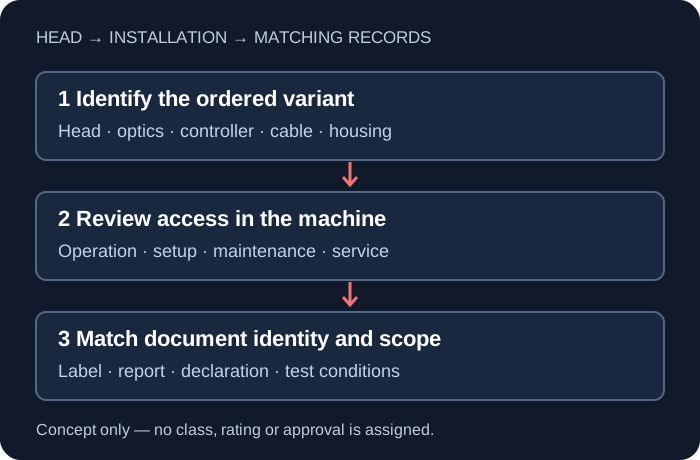
Six questions to resolve before accepting a document package.
| Evidence | Match and request | What remains to be checked |
|---|---|---|
| Product identity | Full order code, optical/output variant, controller, serial applicability and manual revision | A family brochure or similar housing is not the identity of the delivered configuration. |
| Laser classification | Classification basis/edition, accessible-emission report scope and actual product/aperture labels | Wavelength, measuring range and an isolated mW value do not assign a class. |
| Machine integration | Beam/receiver clearance, covers, access states and manufacturer instructions | The head label does not classify the complete machine or every service condition. |
| Destination documentation | Intended market, responsible economic operators and applicable declarations/reporting basis | A logo, acknowledgement or report number is not universal market approval. |
| Environmental performance | Ordered assembly, named test standard/revision, conditions, results and exclusions | IP, temperature, EMC, shock and vibration are separate claims. |
| Review and change control | Document issuer, revision, scope, reviewer, open questions and proposed configuration | An enquiry or received file is not a completed acceptance decision. |
LABEL INTERPRETATION / NO AUTOMATIC CLASSIFICATION
Class labels describe different access conditions.
| Label group | General distinction | Review question |
|---|---|---|
| Class 1 | Lower accessible-emission hazard under the assessed normal-use conditions. | Check the actual product instructions and what changes when housing is opened. |
| Class 1M / 2M | Optical aids can introduce additional viewing hazards. | Identify viewing optics; do not treat the M suffix as interchangeable with Class 1 or 2. |
| Class 2 | A visible-beam class; deliberate or extended viewing can be hazardous. | Avoid intentional beam viewing and review reflections and access. |
| Class 3R | Direct viewing can present an eye hazard. | Have beam access and controls assessed for the actual work. |
| Class 3B / 4 | Higher-hazard classes with distinct control requirements. | Escalate to qualified safety review; these classes are not treated as equivalent or assigned here. |
Selected industrial review distinctions, not a complete classification standard or a protection prescription. No LDS class is inferred. Health Canada class overview ↗
AVAILABLE NOW / BLANK OWNED REGISTER
Track the file that actually belongs to the proposed hardware.
Blank planning register. Enter the actual document issuer and product identity; keep original labels and reports unchanged. A received document is not an acceptance result. No class, rating, certificate or test result is supplied by this worksheet.
8 categories, 10 columns, all entries initially “Not reviewed”. Revision 2026-11-08. No contact details are required. Fill the downloaded file locally; arrange a transfer method before sharing confidential reports.
Read all register fields and categories
Columns to complete
- Evidence category
- Ordered model and variant
- Document or report identifier
- Issuer / manufacturer
- Revision and date
- Standard and edition
- Scope and test conditions
- Open questions
- Responsible reviewer
- Review status
Evidence categories
- Product and assembly identity — Not reviewed
- Laser classification basis and report — Not reviewed
- Actual label and user instructions — Not reviewed
- Machine access and integration review — Not reviewed
- Destination declarations and reporting — Not reviewed
- Enclosure and thermal evidence — Not reviewed
- EMC evidence — Not reviewed
- Shock and vibration evidence — Not reviewed
Keep instrument calibration and measurement acceptance as a separate evidence review. Open the calibration checklist ↗
Classify the accessible emission, not the colour of the beam.
IEC 60825-1 addresses laser-product classification and protective requirements. Record the edition and basis stated for the actual product. A 405 nm blue option, 655 nm red option, point spot or projected line does not establish its class. Pulsed operation, accessible emission and assessment conditions matter; this page does not calculate a class from power shorthand.
Request the label photograph and matching manual/report reference. Keep the real issuer and manufacturer identities intact. A mock warning sticker or a report belonging to a different product must not stand in for those records.
A classified head is only one part of the machine review.
Document how the beam is accessible in normal operation, setup, maintenance and service. Include target movement, reflective surfaces, external optics and any changed protective housing. Do not defeat covers or interlocks to investigate an unknown beam.
The machine builder and responsible safety reviewer need to assess the completed installation. Specify any separately required protective system; a distance output, alarm bit or IO-Link connection does not establish a certified personnel-protection function. Component and final-product obligations depend on how the item is supplied and used.
Request market evidence without treating a badge as approval.
For an EU destination, identify the applicable product rules and obtain the matching EU declaration and supporting document scope where required. The European Commission explains that CE marking is a manufacturer declaration, not an EU safety approval or indication of origin. Do not infer EU manufacture from the marking.
For the United States, ask the responsible manufacturer/importer to identify the applicable FDA laser-product requirements and any guidance basis, including Laser Notice 56 where relevant. FDA states that an accession number acknowledges a report; it does not approve the product. Requirements for other destinations need their own review rather than borrowing a CE or FDA claim.
Keep material and electrical evidence separate: RoHS concerns restricted substances in electrical/electronic equipment, while any claimed FCC compliance needs its own applicable equipment and documentation basis. Neither substitutes for laser classification. Ask the responsible party to confirm the current rules and scope for the destination and proposed assembly.
Keep ingress, thermal and electromagnetic evidence separate.
An IP claim concerns an enclosure assessment under its stated standard and test conditions. Ask whether the tested arrangement includes the actual connectors, mating cables, windows and accessories. Do not convert an immersion claim into a washdown claim or assume a protective housing raises the head’s rating.
For EMC, record the tested configuration, cable lengths/shields, operating modes, applied levels and performance criteria. For shock/vibration, retain axes, fixture, waveform or sweep, amplitude, frequency, duration and acceptance criteria. For temperature or cooling, identify the operating limits, medium/flow conditions and condensation constraints. A calibration report cannot replace these records.
PROPOSED REVIEW / NOT A COMPLETED TEST
Make the checks part of the agreed project scope.
Identify the supplied assembly
List the head, optics, controller, firmware, connectors, cables, protective housing and destination before requesting evidence.
Collect the matching records
Ask for labels/manual, classification basis, declarations and applicable environmental reports. Mark absent or mismatched files as open questions.
Review the actual access and process
Have the responsible machine/EHS team assess installation and service access using the manufacturer instructions and applicable requirements.
Record the decision and changes
Retain the reviewer, document revisions, unresolved limitations and changes that trigger reassessment. Do not mark a file accepted merely because it was received.
The proposed checks do not establish a released LDS model, completed calibration, accreditation or certified machine-safety function.
Questions before you request the files
Can I assume every LDS family is Class 1 or Class 2?
No. Laser class is configuration-specific and must come from the matching label, documentation and classification basis. This guide assigns no class to LDS-TRI, LDS-PRO, LDS-2D or LDS-LNG.
Does a Class 1 label cover an opened machine?
A classification applies under its assessed conditions. Opening protective housing or changing access may reveal a different exposure. Follow the actual product instructions and have the responsible reviewer assess setup and service.
Does a blue or low-power laser remove the need for an exposure review?
No. Colour and a nominal power value are insufficient to classify the product or choose protection. Have the actual emission, access conditions and instructions reviewed; this page does not prescribe eyewear or an exposure distance.
Does an FDA accession number or CE logo prove approval?
FDA says its acknowledgement/accession number does not approve a product. CE marking is a manufacturer declaration against applicable EU rules, not EU safety approval or proof of origin. Review the actual model, responsible party and document scope.
Does IP67 prove resistance to hot washdown, vibration or electrical interference?
No. Request the specific enclosure test and conditions, and separate thermal, shock/vibration and EMC evidence for the ordered assembly. A protection label alone does not establish all environmental performance.
Can I download an LDS safety certificate here?
The available download is an owned blank evidence register, not a certificate or test report. Request configuration-specific safety/environmental files and confirm their availability, issuer, identity and revision before use.
Request evidence for your actual configuration.
Send the full device and controller model, measuring requirement, document revisions already held, quantity and destination. Ask to agree an NDA and transfer method before sharing confidential drawings.
Download or read the project worksheet ↗HARDWARE / INSTALLATION REFERENCE
Review the head, enclosure and optical opening together.
Protective hardware needs its own fit, thermal and optical review. Appearance does not establish a laser class, IP rating or certified safety function.
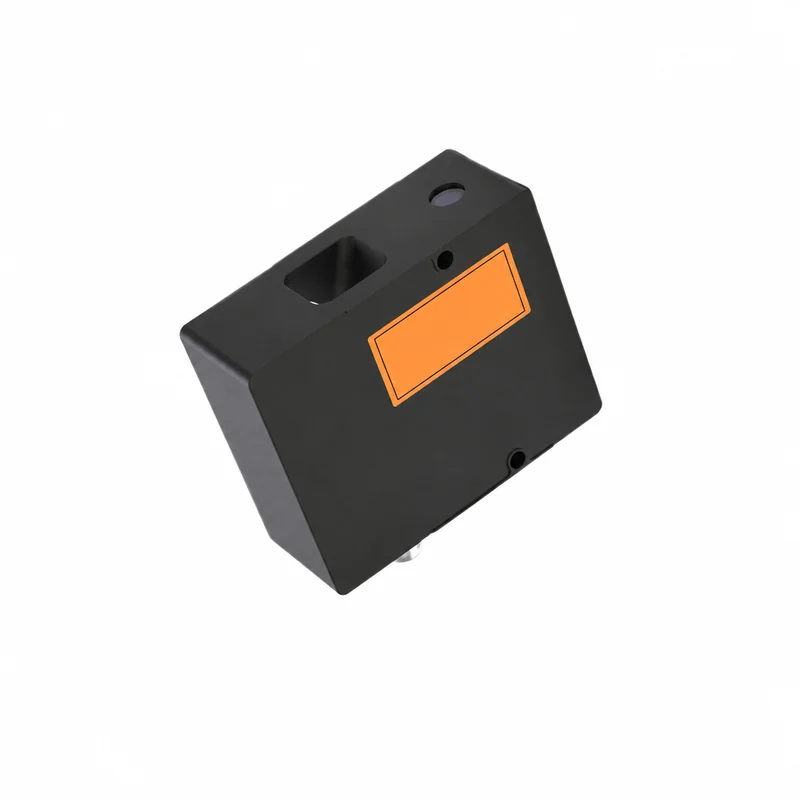
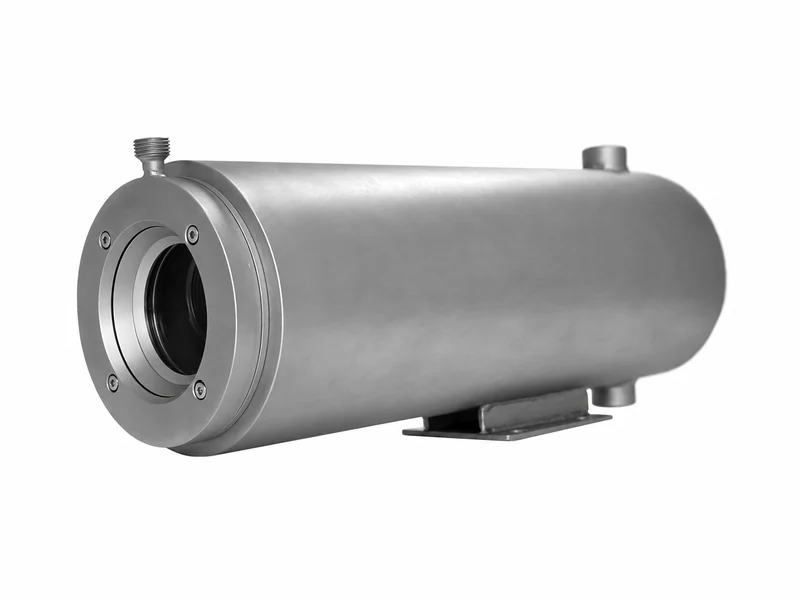
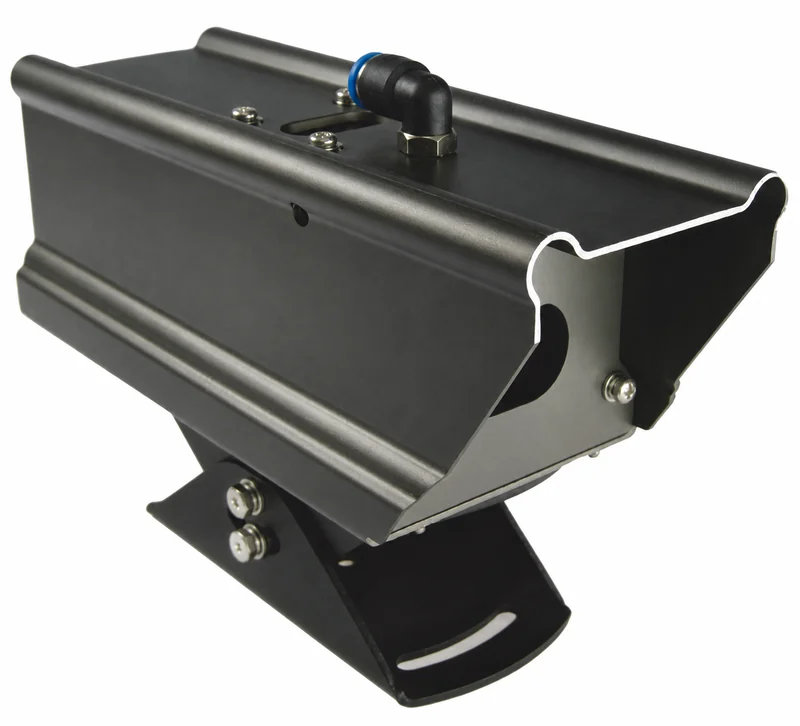
Representative housing views. Confirm the exact model, dimensions and supply scope. Housing color does not identify laser wavelength.